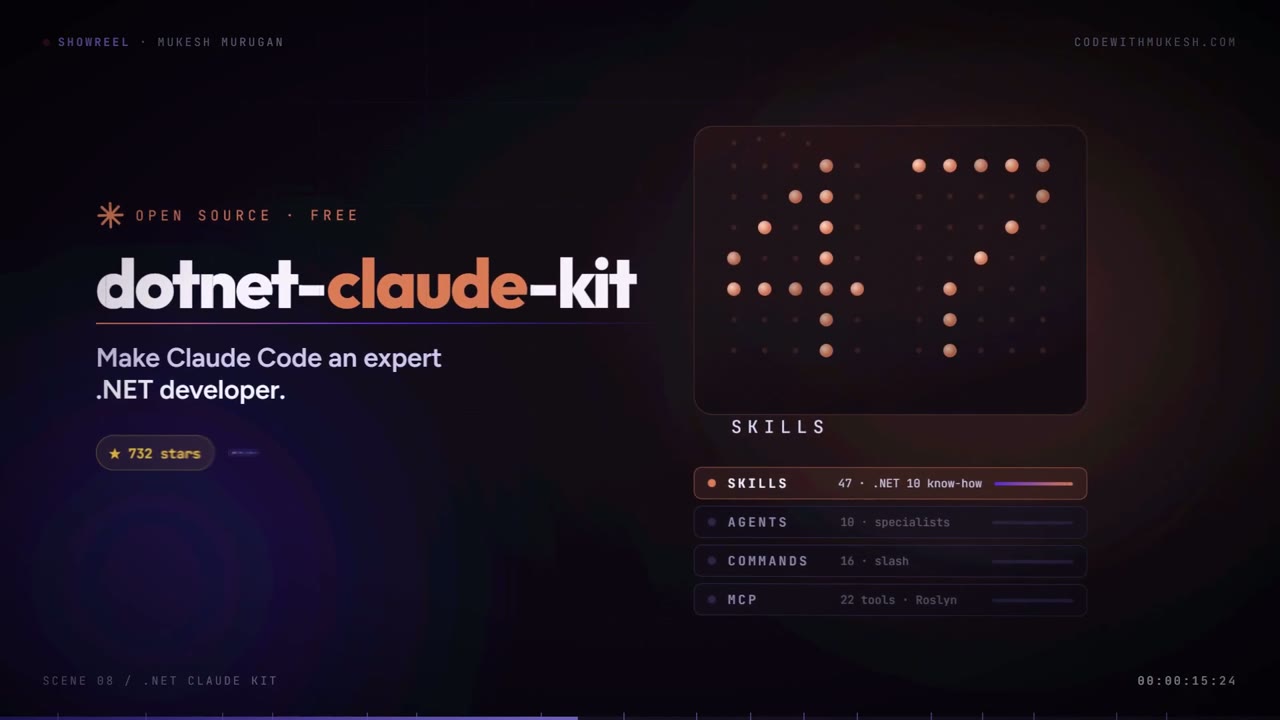
Developer showreel stacks .NET layers and AWS course stats

1.6K views · 23 likes · 14 saves · 5 reposts · Posted Sep 25, 2026 · 0:35 · Motion graphics
OUR NOTEA 30-second personal showreel for a .NET developer and creator: a typed quote, an isometric stack of his open-source starter kit, an AWS-for-.NET course card and LinkedIn/X post cards, which Opus 5.5 built in Remotion over about 20 minutes.
Claude Opus 5.5 is incredible.

I gave it a pretty simple task:

Create a Remotion-based showreel featuring my work as a developer, content creator, and open-source maintainer.

What I wanted was a cool 30-second motion graphic that introduces  me as a developer and content creator.

That was basically it.

Claude went to work for around 20 minutes, writing the Remotion code, putting together the animations, transitions, layouts, and the overall story.

And this is what it produced.

Stunning, right?!

What surprised me most is that this isn't just AI generating a few video clips.

It's AI building the video programmatically.

The entire thing is code.

Which means I can tweak the content, change the animations, swap assets, update numbers, or completely redesign a section - and render it again.

Video generation was one of those things I thought would take AI quite a while to really crack.

Turns out we're already much closer than I expected.

And for developers, tools like Remotion + coding agents open up some seriously interesting possibilities.

Interested in knowing what prompt I used?

Comment "Remotion".THE PROMPT
Partial prompt — the creator shared only part of it.
Claude Opus 5.5 is incredible.
I gave it a pretty simple task:
Create a Remotion-based showreel featuring my work as a developer, content creator, and open-source maintainer.
What I wanted was a cool 30-second motion graphic that introduces me as a developer and content creator.
That was basically it.
Claude went to work for around 20 minutes, writing the Remotion code, putting together the animations, transitions, layouts, and the overall story.
And this is what it produced.
Stunning, right?!
What surprised me most is that this isn't just AI generating a few video clips.
It's AI building the video programmatically.
The entire thing is code.
Which means I can tweak the content, change the animations, swap assets, update numbers, or completely redesign a section - and render it again.
Video generation was one of those things I thought would take AI quite a while to really crack.
Turns out we're already much closer than I expected.
And for developers, tools like Remotion + coding agents open up some seriously interesting possibilities.
Interested in knowing what prompt I used?
Comment "Remotion".MAKE ONE LIKE THIS
Three steps, using what the creators in this index used.- 1 · Copy the prompt
Use the prompt above as your starting point, then change the subject and the style.
HOW OTHERS WROTE THEIRS → - 2 · Direct it like an editor
- Ask for one self-contained HTML file on a fixed 1920×1080 stage.
- Link this video as the reference for pacing and style.
- Send two or three rounds of specific notes.
- 3 · Render it to MP4
A short piece like this can be screen-recorded, or captured frame by frame for exact timing.
TURN AN HTML ANIMATION INTO AN MP4 →
The creator didn't name their tools. Most videos like this are HTML, canvas or SVG animation written by Claude and screen-recorded or rendered to MP4 — how that works.
Indexed Sep 30, 2026, 2:01 PM · Views as of indexing. Video and post © their creator.