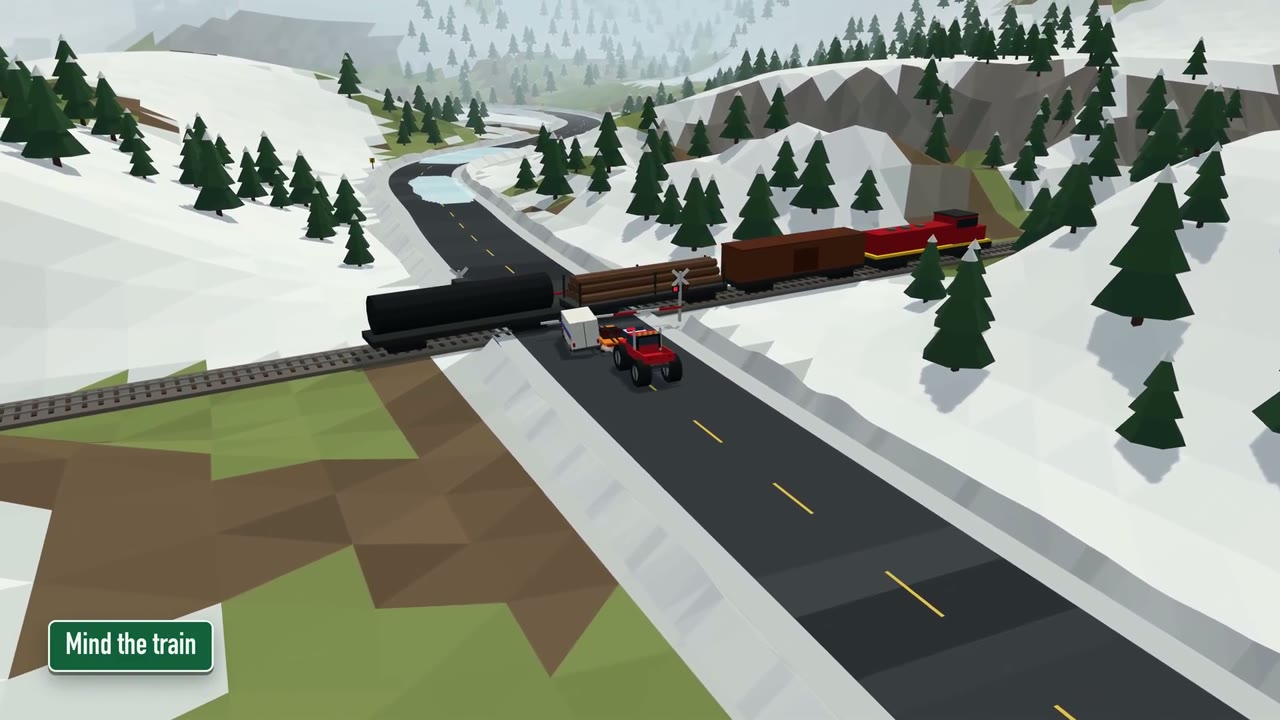
Low-poly racing game trailer for an original arcade title

nieGRAMotnyVERIFIED
@_nieGRAMotny_293 views · 10 likes · 3 saves · 1 reposts · Posted Sep 24, 2026 · 0:30 · Interactive
OUR NOTEA trailer for an original low-poly racing game inspired by 1990s arcade racers, showing four distinct vehicles crossing a checkered finish line through a snowy town; built in Three.js with custom 2.5D physics.
THE CREATOR'S POST
Thawline: How Opus 5.5 Creates a Game from a Single Prompt
As promised in my previous post, here is a look at how Anthropic's new model generates a game using just one prompt.
The results shown in the video and screenshots were created by the Opus 5.5 Extra High model, using my $20/month Claude Pro plan.
Development time: 1.5 hours (building the game including all assets)
Output tokens: 415k
Total tokens: 50.8M
Cost: $23.50
On top of that, I decided to use Claude to prepare a ZIP archive for an Itch release, take "promotional" screenshots, and create a 30-second trailer. This took about 80 minutes (compare that to making the actual game) and cost less than $7 in total.
In the comments below, I am sharing the link to the playable version along with the prompt. It is worth noting that Claude initially suggested breaking the game's development into 5 steps, but I insisted on keeping it to a single one.
Where does Thawline sit on the "slop scale," and are all these 20-minute, single-prompt Fortnite clones actually real, or just marketing hype?THE PROMPT
Detailed game-design specBuild a racing game inspired by Ignition (1997): angled top-down camera, arcade-leaning
physics, vehicles with very distinct personalities. This must be an original game,
not a copy. Use an original name, an original track, and zero original assets.
## Stack
- Vite + TypeScript (strict), Three.js for rendering, no UI framework
(HUD in plain DOM/CSS).
- Low-poly graphics generated in code (BoxGeometry, CylinderGeometry, etc.),
no external models or textures. Solid colors and simple materials.
- Custom simplified 2.5D physics (movement on the XZ plane, height from terrain).
No physics engine.
## Architecture
- src/game/ (game loop with fixed timestep), src/vehicles/, src/track/, src/ai/,
src/render/, src/ui/
- Vehicles are data-driven: mass, power, top speed, grip, steering, collision
resistance, and boost parameters (strength, duration, recharge time).
One Vehicle class, different configurations.
- Any vehicle can be controlled by either the player or the AI
(shared control interface: throttle, brake, steer, boost).
- Track as data: centerline spline + width + list of zones
(ice, shortcut, obstacle). Generate the road mesh and AI waypoints from it.
## Vehicles (original names, no brands)
Four vehicles. The player picks one on the selection screen; the remaining 3
are driven by the AI.
- 90s-style police sedan (black and white, light bar): heavy, stable,
pushes hard in collisions.
- Muscle car convertible: fastest on straights, oversteers in corners.
- Red monster truck: slow, but ignores bumps and rams everything else.
- Postal delivery van: slow, high center of gravity, sways in corners.
The handling differences must be clearly noticeable. All four must be playable
and competitive. Slower vehicles compensate with e.g. collision resistance,
terrain handling, or a stronger or more frequent boost.
## Boost
- Every vehicle has a boost: a short, pronounced acceleration beyond its
normal top speed.
- Boost charges automatically from 0 to 100%. It can only be used at 100%.
After use, the meter drops to 0 and starts charging again.
- Strength, duration and recharge time are unique to each vehicle
(e.g. muscle car: short and very strong; van: weaker but recharges fast;
monster truck: long but slow to recharge).
- Visual effect while boosting: exhaust flame or trail, slight camera
pull-back.
- The AI also uses boost, sensibly: on straights, not before sharp corners
or on ice.
## Track
A mountain town with a Canadian feel, winter turning into spring thaw:
- closed loop, roughly 60–90 seconds per lap
- a waterfall visible from the track and a wooden bridge over a river
- a railroad crossing with a train passing periodically
(collision = strong knockback, not game over)
- ice patches with reduced grip
- one shortcut (tight, risky); decorations: spruce trees, wooden houses, snow
- barriers or natural obstacles so vehicles can't get stuck off the track.
Failsafe: if a vehicle (including bots) is stuck for more than ~4 s,
automatically return it to the track at the last checkpoint.
## Gameplay
- 3 laps, standing grid start, 3-2-1 countdown
- AI follows waypoints with a driving style that depends on the vehicle,
light rubber-banding, avoids obstacles, no teleporting (except the
failsafe track return described above)
- Sliding comes purely from physics (grip, speed, ice), no handbrake
- Camera: top-down at ~50°, follows the player with a slight look-ahead
in the direction of travel
- Controls: arrows/WASD (throttle, brake/reverse, steering), space = boost
- Screens: start → vehicle selection (model preview + stat bars, including
boost) → race → results → restart (with option to change vehicle)
## HUD
- Position, lap, lap time, best lap, minimap.
- Boost meter styled as a car battery: rectangular casing with two terminals
(+/−) on top, fill level rises as it charges. Color shifts from red through
yellow to green. At 100% the battery clearly signals readiness (pulsing or
glow, "BOOST" label or lightning bolt icon). While boosting, the meter
drains quickly.
## Out of scope for v1
Sound, options menu, multiple tracks, multiplayer, save state.
## Workflow
1. First propose a plan and file structure, then implement in stages:
(a) game loop + one vehicle on a flat plane, including boost,
(b) track, (c) remaining vehicles and AI, (d) obstacles and train,
(e) vehicle selection, HUD with battery meter, and screens.
2. After each stage run `npm run build` and fix type errors.
3. Add unit tests (Vitest) for vehicle physics, boost logic (charging,
lockout below 100%, reset after use), and lap/position logic.
4. Finally: a README describing the controls and how to add a new track
or vehicle.
## Acceptance criteria
`npm install && npm run dev` launches the game. You can pick any of the 4
vehicles and complete 3 laps against 3 bots. Each vehicle handles differently
and has a noticeably different boost. Boost only works with a full battery,
and bots use it too. The train and ice work. Results show the correct order.
Stable 60 FPS on an average laptop.MAKE ONE LIKE THIS
Three steps, using what the creators in this index used.- 1 · Copy the prompt
Use the prompt above as your starting point, then change the subject and the style.
HOW OTHERS WROTE THEIRS → - 2 · Direct it like an editor
- Ask for one self-contained HTML file on a fixed 1920×1080 stage.
- Link this video as the reference for pacing and style.
- Send two or three rounds of specific notes.
- 3 · Render it to MP4
A short piece like this can be screen-recorded, or captured frame by frame for exact timing.
TURN AN HTML ANIMATION INTO AN MP4 →
HOW IT WAS MADE
The creator didn't name their tools. Most videos like this are HTML, canvas or SVG animation written by Claude and screen-recorded or rendered to MP4 — how that works.
LOOK
game3dsimulation
Indexed Sep 28, 2026, 8:28 AM · Views as of indexing. Video and post © their creator.