Zoom from a CPU cooler down to single silicon atoms

177 views · 6 likes · 4 saves · 1 reposts · Posted Sep 26, 2026 · 0:44 · 3d scenes
OUR NOTEA continuous 3D scale-study shot rendered in the browser that dives from a desktop PC past the CPU cooler and lid into compute dies, rows of logic cells and finally a lattice of silicon atoms, with a scale ruler tracking the size.
I TRIED MAKING A 3D MOTION GRAPHIC WITH CLAUDE OPUS 5.5. THIS IS WHAT CAME OUT.

The idea was simple: start at my desk and don't stop zooming until we hit a single atom inside the CPU.

Opus 5.5 took it and just kept going.

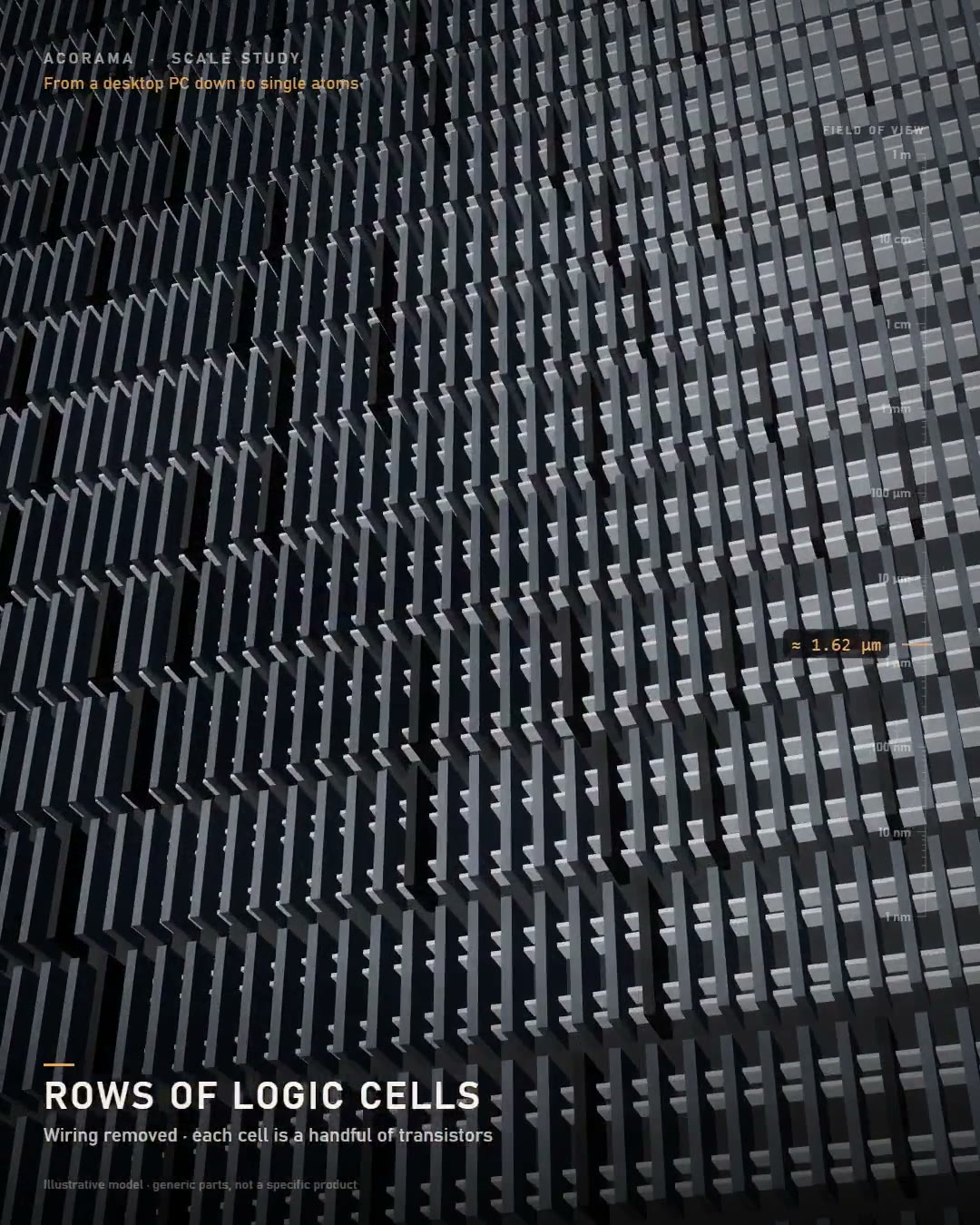
Into the PC case. The cooler lifts off. The CPU under it. The metal lid comes off. Then the silicon die, one core, the copper wiring stacked on top, rows of logic cells, the fins and gates of the transistors…

…all the way down to one silicon atom, bonded to its four neighbours.

One continuous shot, no cuts. The ruler on the right tracks the scale the whole time: from about a metre down to about 2 nanometres.

And the part that still gets me: every frame of this is 3D rendered right in a browser, from code. No Blender, no After Effects, no stock footage.

A year ago this would have been a studio job. Now it's one conversation.

Opus 5.5 is on another level.THE PROMPT
Partial prompt — the creator shared only part of it.
I TRIED MAKING A 3D MOTION GRAPHIC WITH CLAUDE OPUS 5.5. THIS IS WHAT CAME OUT.
The idea was simple: start at my desk and don't stop zooming until we hit a single atom inside the CPU.
Opus 5.5 took it and just kept going.
Into the PC case. The cooler lifts off. The CPU under it. The metal lid comes off. Then the silicon die, one core, the copper wiring stacked on top, rows of logic cells, the fins and gates of the transistors…
…all the way down to one silicon atom, bonded to its four neighbours.
One continuous shot, no cuts. The ruler on the right tracks the scale the whole time: from about a metre down to about 2 nanometres.
And the part that still gets me: every frame of this is 3D rendered right in a browser, from code. No Blender, no After Effects, no stock footage.
A year ago this would have been a studio job. Now it's one conversation.
Opus 5.5 is on another level.MAKE ONE LIKE THIS
Three steps, using what the creators in this index used.- 1 · Copy the prompt
Use the prompt above as your starting point, then change the subject and the style.
HOW OTHERS WROTE THEIRS → - 2 · Direct it like an editor
- Ask for one self-contained HTML file on a fixed 1920×1080 stage.
- Link this video as the reference for pacing and style.
- Send two or three rounds of specific notes.
- 3 · Render it to MP4
A short piece like this can be screen-recorded, or captured frame by frame for exact timing.
TURN AN HTML ANIMATION INTO AN MP4 →
The creator didn't name their tools. Most videos like this are HTML, canvas or SVG animation written by Claude and screen-recorded or rendered to MP4 — how that works.
Indexed Sep 30, 2026, 2:01 PM · Views as of indexing. Video and post © their creator.